Unlocking the Power of Machine Learning in Cryptography and Security 🔐
How AI is Revolutionizing Data Protection and Threat Detection

Machine learning (ML) has become a game-changer in cryptography and cybersecurity. Its ability to analyze vast datasets and identify elusive patterns surpasses traditional methods, marking significant progress in data protection strategies. As cyber threats grow increasingly sophisticated, ML integration not only improves cryptographic systems but also aids in detecting and mitigating potential security breaches.
Article Key Takeaways
Machine learning enhances cryptography through improved key generation and cryptanalysis.
AI-powered intrusion detection systems provide real-time threat analysis and response.
Challenges remain in data quality, computational demands and model vulnerabilities.
Future trends include quantum cryptography advancements and enhanced privacy mechanisms.
Ethical considerations and collaborative research drive innovation in this field.

The Marriage of Machine Learning and Cryptography
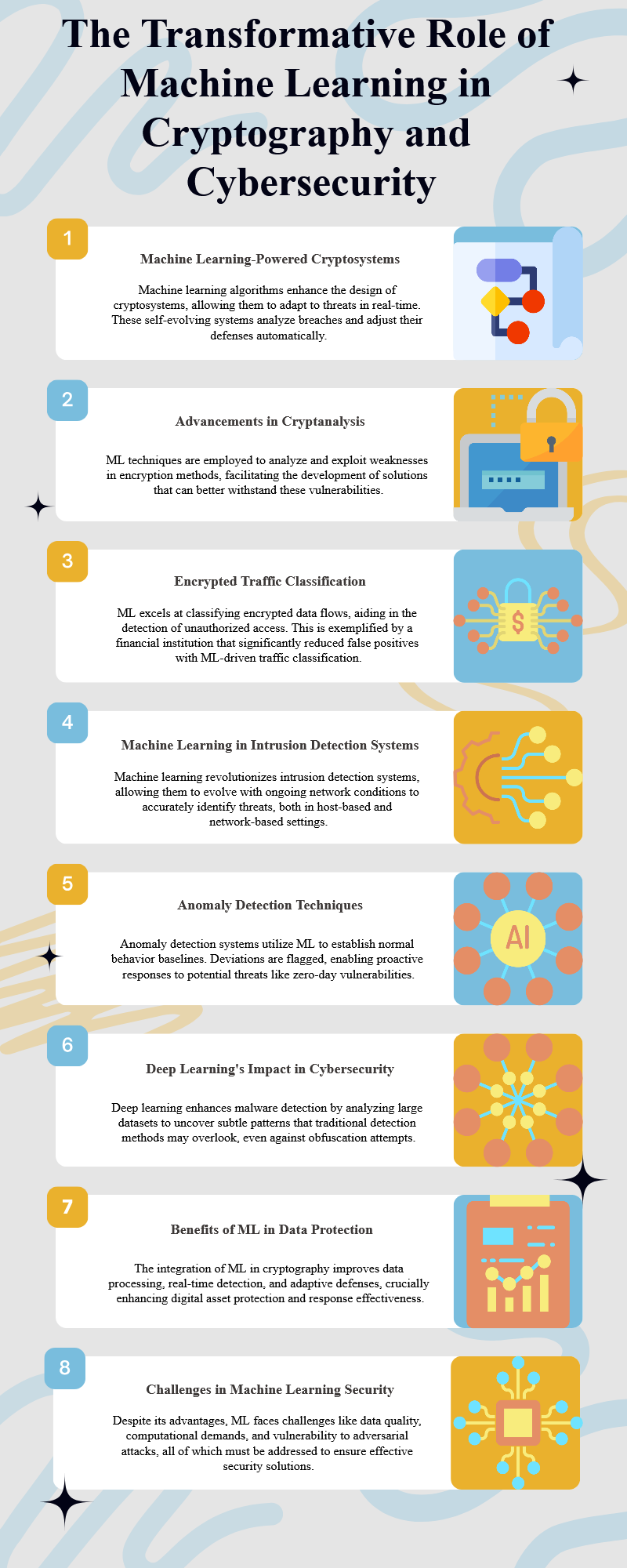
ML techniques find applications in designing both symmetric and asymmetric cryptosystems. This enables development of adaptive security measures evolving alongside emerging threats. These algorithms can automate cryptographic key generation and bolster cryptanalysis efforts which involve breaking encryption to uncover vulnerabilities. However, ML use in this domain raises concerns about potential machine-learning-enabled attacks exploiting weaknesses in cryptographic protocols.
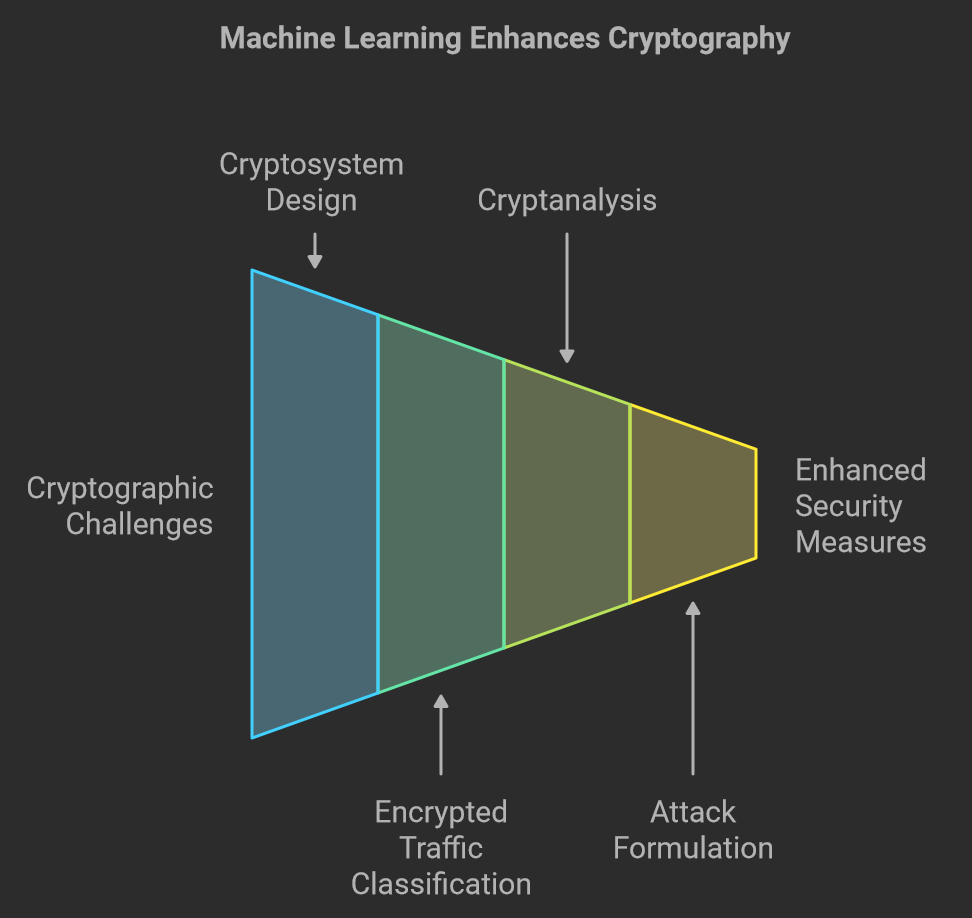
Machine learning applications in cryptography span various areas:
Cryptosystem design
Encrypted traffic classification
Cryptanalysis
Attack formulation
Supervised Learning in Cybersecurity
Supervised learning trains models on labeled datasets predicting outcomes for new unseen data. In cybersecurity, these techniques distinguish between benign and malicious data. Models trained on known attack patterns predict potential threats by analyzing incoming data.
Unsupervised Learning for Anomaly Detection
Unsupervised learning identifies patterns or groupings within data without labels. This approach uncovers new attack patterns or adversary behaviors without prior knowledge. Clustering techniques discover hidden structures in datasets aiding threat detection and response.
Reinforcement Learning in Adaptive Security Systems
Reinforcement learning involves an agent learning through environment interaction making decisions based on rewards. This approach develops adaptive security systems evolving with user interactions and environmental changes. RL algorithms applied to intrusion detection systems enhance accuracy and responsiveness in real-time.

Machine Learning in Intrusion Detection Systems
ML plays a pivotal role in enhancing cybersecurity frameworks particularly in developing and implementing intrusion detection systems (IDS). These systems analyze security data from multiple network sources identifying potential internal and external threats.
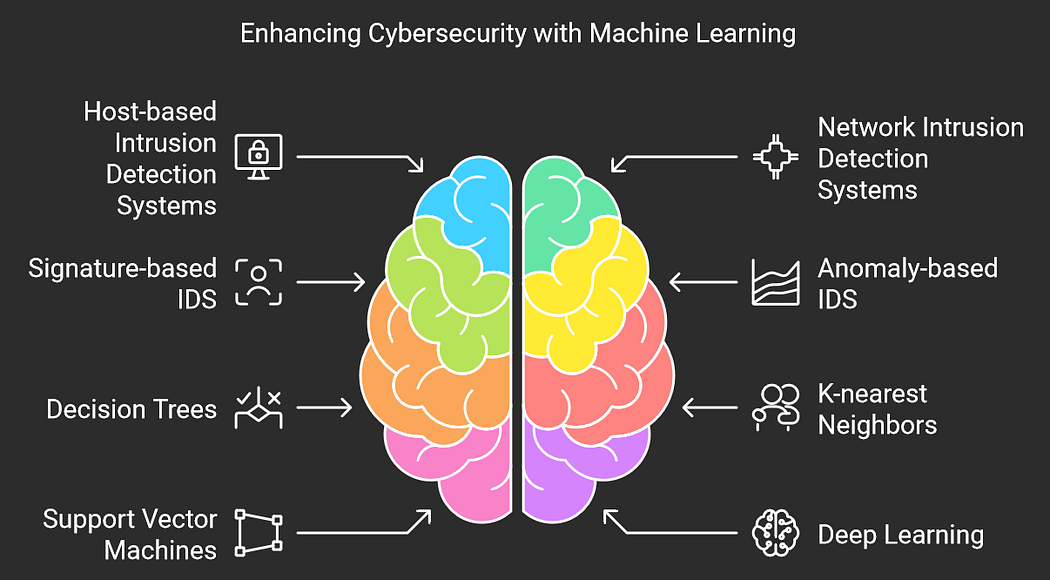
Types of Intrusion Detection Systems
Host-based Intrusion Detection Systems (HIDS): Monitor individual system files detecting unauthorized access or modifications.
Network Intrusion Detection Systems (NIDS): Scrutinize network traffic identifying malicious activity that may indicate ongoing attacks or security breaches.
Methodologies in Intrusion Detection
Signature-based IDS: Relies on predefined patterns of known threats matching current network activity against these signatures.
Anomaly-based IDS: Establishes normal behavior baseline flagging deviations as potential threats allowing identification of previously unknown attack patterns.
Various machine learning techniques including decision trees k-nearest neighbors (KNN) and support vector machines (SVM) improve intrusion detection system accuracy and effectiveness. A hybrid approach using decision trees and KNN shows promise in detecting network traffic anomalies.
Deep learning — a subset of machine learning — utilizes artificial neural networks analyzing vast amounts of data. This method proves particularly effective where traditional ML algorithms struggle such as with large cybersecurity datasets. Deep learning’s capability to extract features and detect complex patterns allows it to outperform classical methods in certain applications.
Advantages of Machine Learning in Cryptography and Security
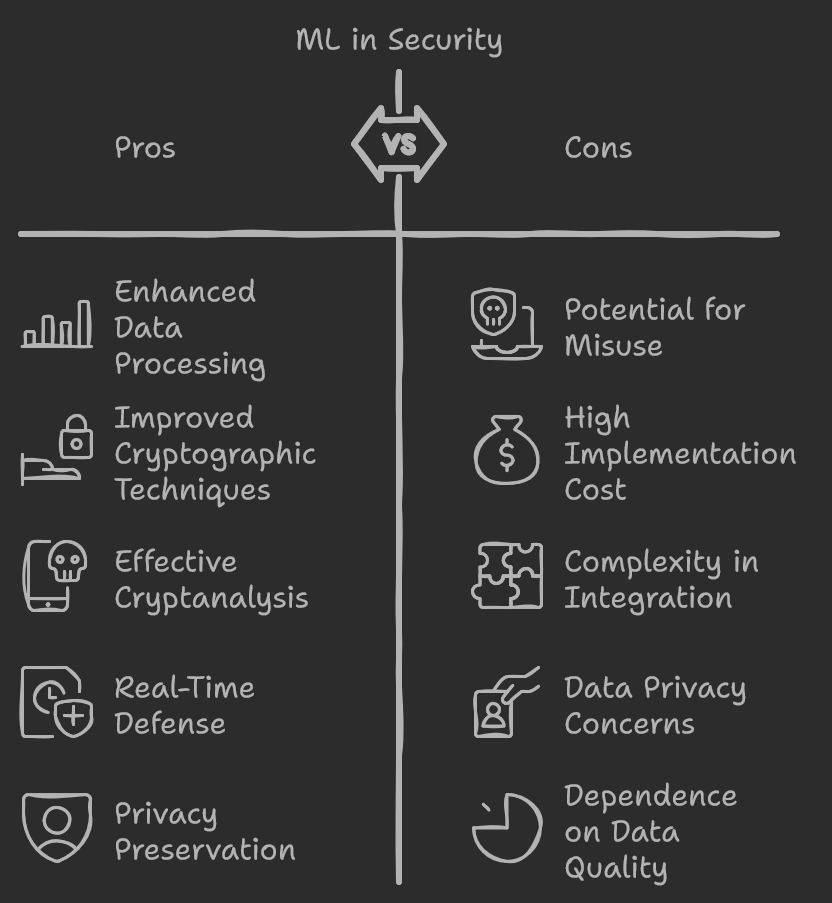
ML offers several benefits enhancing traditional security measures:
Enhanced Data Processing: ML algorithms efficiently analyze extensive datasets identifying patterns and anomalies indicating security breaches or cryptographic system vulnerabilities.
Improved Cryptographic Techniques: ML develops advanced cryptographic algorithms designing symmetric and asymmetric cryptosystems adapting to evolving threats.
Effective Cryptanalysis: ML techniques enhance cryptanalysis — breaking cryptographic systems — by analyzing encryption methods and identifying weaknesses enabling faster more efficient decryption processes.
Adaptability and Real-Time Defense: ML enables development of real-time adaptive defense mechanisms detecting and counteracting potential attacks as they occur.
Privacy Preservation: Privacy-preserving techniques like differential privacy and homomorphic encryption integrate with ML safeguarding sensitive information during learning processes.
Scalability and Efficiency: ML facilitates development of lightweight efficient defense mechanisms accommodating increasing loads without compromising performance.

Challenges and Limitations
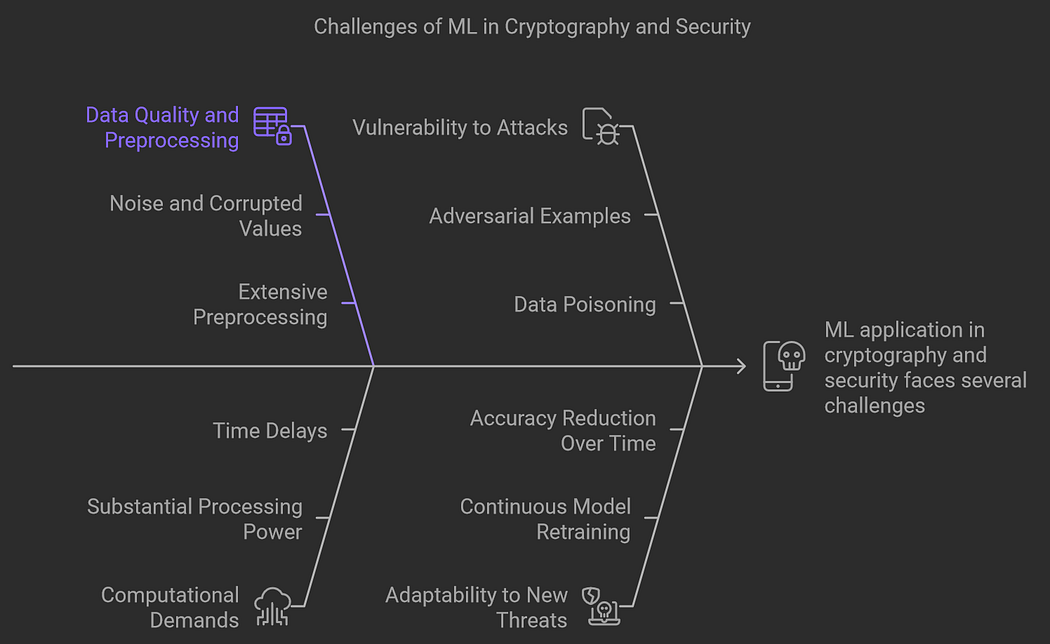
Despite its advantages ML application in cryptography and security faces several challenges:
Data Quality and Preprocessing: Security data often contains noise missing or corrupted values requiring extensive preprocessing to ensure accuracy and relevance.
Computational Demands: ML models particularly deep learning algorithms require substantial processing power and time potentially causing delays in real-time threat detection.
Vulnerability to Attacks: ML models remain sensitive to sophisticated malicious attacks like adversarial examples and data poisoning necessitating stronger defensive measures.
Feature Selection Challenges: Incorrect or suboptimal feature choices significantly degrade model performance complicating deployment of ML solutions for security.
Adaptability to New Threats: The dynamic cyber landscape requires continuous model retraining or significant adjustments complicating deployment and potentially reducing accuracy over time.
Privacy and Security Concerns: Ensuring privacy while using ML techniques presents additional challenges. Federated learning (FL) addresses some privacy concerns but remains vulnerable to model poisoning and inference attacks.
Resource Management: Implementing sophisticated ML systems requires powerful computational resources posing challenges in resource-limited environments.
Future Trends
As technology evolves integrating machine learning with cryptography and security presents promising future trends:
Advancements in Quantum Cryptography
The convergence of AI and quantum computing redefines secure communications. Quantum key distribution (QKD) protocols optimize using ML capabilities allowing real-time quantum state analysis and enhanced security measures against eavesdropping. This fusion creates ultra-secure communication channels resilient to both classical and quantum threats transforming sectors like online banking e-commerce and healthcare.

Enhanced Data Privacy Mechanisms
Implementing federated learning (FL) systems addresses data privacy regulations and challenges in decentralized ML environments. As organizations navigate complex evolving privacy laws FL’s adaptability helps maintain data integrity while complying with legal requirements.
Machine Learning in Cybersecurity
ML’s role in cybersecurity expands enabling faster threat detection and automated incident responses. It assists in network traffic analysis and fraud detection becoming a cornerstone of modern defense strategies. Future developments leverage ML to create more sophisticated cryptographic algorithms and improve cryptanalysis techniques strengthening data security measures.
Ethical Considerations and Sustainability
Rapid advancement of AI and quantum technologies necessitates thorough examination of ethical implications. Researchers and policymakers must prioritize sustainability and flexibility in designing new cryptographic mechanisms ensuring long-term efficacy and adaptability to technological changes.
Collaborative Research and Development
Future trends emphasize collaboration between academia industry and policymakers fostering innovation in quantum cryptography and machine learning. Joint efforts in research and infrastructure investment effectively address challenges and drive progress in this rapidly evolving field.

Further References
Sponsor Workshop: Mark Ibrahim — Facebook: Machine Learning on Encrypted Data with CrypTen
Keynote — Dr. Najwa Aaraj — What would Quantum Computing and Machine Learning do to crypto?
Deep Learning Applications in Cryptography and Cybersecurity
Infography
Conclusion
Machine learning’s integration into cryptography and security marks a significant advancement in data protection and threat detection. While challenges persist in areas like data quality computational demands and model vulnerabilities ongoing research and development promise to address these issues. The future of this field lies in quantum cryptography enhanced privacy mechanisms and ethical considerations driving innovation through collaborative efforts.
As we navigate this evolving landscape it’s crucial to stay informed about latest developments and their implications for data security. By understanding both the potential and limitations of ML in cryptography and security we can better prepare for future challenges and opportunities in this dynamic field.
Remember security isn’t just about technology — it’s about people too. Stay vigilant stay informed and embrace the power of machine learning to protect your digital assets. 🛡️💻


